
The 2026 ATS Resume Checklist: What Machines (and Recruiters) Scan in the First 6 Seconds
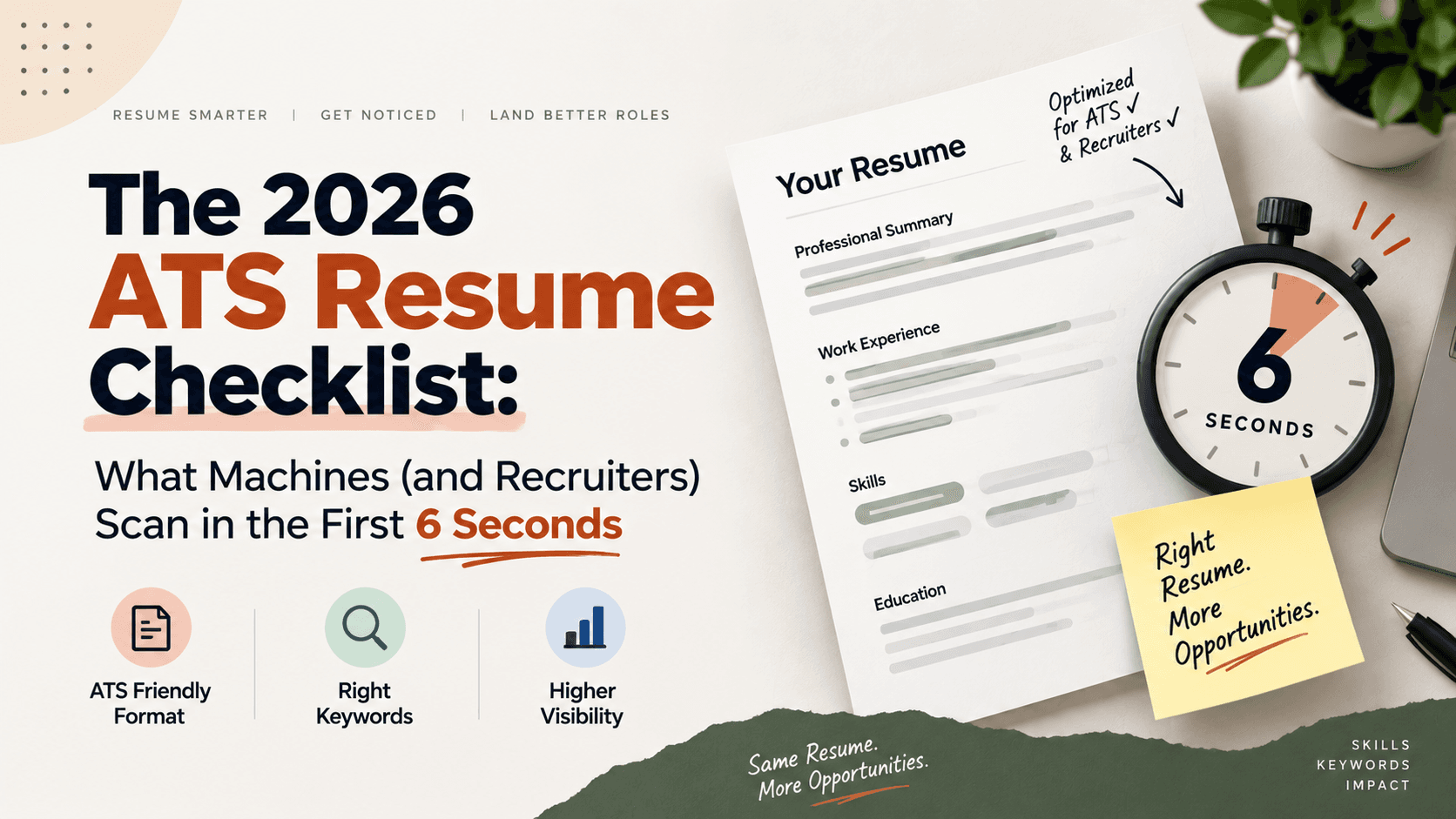
Use this 2026 ATS resume checklist to pass parser-friendly formatting, semantic skill matching, and recruiter skim tests—without keyword stuffing or ugly templates.
What Actually Happens in the First 6 Seconds
Recruiters have long said they spend seconds skimming a resume. In 2026, those seconds are split between a machine and a human. Before your PDF reaches a recruiter's monitor, an Applicant Tracking System parses it into fields—name, titles, dates, skills—and scores your fit against the job description. An AI-assisted layer may then summarize your profile, compare you to other applicants, and highlight missing competencies.
That means your resume needs to survive two-layer ATS and LLM screening and still impress a tired human on a Monday morning. This checklist is built for that reality: practical, ordered, and focused on what parsers and semantic engines actually consume.
Layer 1: Parser-Friendly Formatting (Non-Negotiable)
ATS parsers are better than they were five years ago, but they still stumble on creative design. If the machine cannot read your role dates, you may be ranked incorrectly—or dropped entirely.
File Type and Layout
- Submit PDF or .docx as requested; when unspecified, PDF with selectable text is safest.
- Use a single column layout—multi-column designs scramble reading order.
- Avoid headers/footers for critical information (phone, email)—some systems strip them.
- Skip text boxes, tables for work history, skill bars, icons, and infographic charts.
- Use standard fonts (Arial, Calibri, Helvetica, Times) at 10–12 pt body size.
- Margins around 0.5–1 inch; consistent spacing between sections.
Section Labels Machines Expect
Use conventional headings parsers map to database fields:
- Summary or Professional Summary
- Experience or Work Experience
- Education
- Skills or Technical Skills
- Certifications (if applicable)
Creative headings like "My Journey" or "Impact Playbook" confuse extraction models. Save personality for bullet content, not structure.
Layer 2: Semantic Matching Without Keyword Stuffing
Older ATS advice told candidates to mirror every keyword from the job description. In 2026, that tactic often backfires. Systems use semantic matching—they understand that "PostgreSQL" relates to "relational databases" and that "led a cross-functional team" signals project leadership even if the exact phrase is absent.
Do This Instead of Stuffing Keywords
- Identify 5–8 core competencies from the job description—tools, domains, responsibilities.
- Ensure each competency appears once in context: a bullet proving you used it, not a repeated skills list.
- Use synonyms naturally: "A/B experiments" and "controlled experiments" both support product analytics roles.
- Align job titles where honest—if you were "Member of Technical Staff" but functionally a senior backend engineer, clarify in a subtitle or first bullet.
Keyword stuffing creates noisy resumes that score oddly on semantic models and read poorly to humans. Evidence beats repetition.
GEO: Make Your Resume AI-Readable
Generative Engine Optimization (GEO) is usually discussed for websites, but the concept applies to resumes too. LLM-assisted recruiters and internal tools "read" your resume as structured narrative data. An AI-readable resume answers predictable questions:
- What roles did this person hold, when, and for how long?
- What tools and methods did they use?
- What outcomes did they deliver—with numbers?
- What level of scope (team size, budget, users, revenue) did they influence?
Write bullets so each one stands alone as a micro-story: action, method, result. This helps both GEO-style retrieval and human skim reading.
The 2026 ATS Resume Checklist (Print This)
Work top to bottom before you submit any application.
Header and Contact
- Full name prominent; professional email; phone with country code if relevant
- City and state/country (full remote candidates: list location + "Open to remote")
- LinkedIn URL customized; portfolio/GitHub if role-relevant
- No photo unless required by local convention—many U.S. ATS pipelines ignore or mishandle images
Professional Summary (3–4 Lines)
- Role target + years of experience + domain
- Two proof points with metrics
- Plain language—no buzzword soup
Experience Section
- Reverse chronological order
- Each role: job title, company, location, start/end dates (month + year)
- 3–6 bullets for recent roles; fewer for older history
- Quantify achievements wherever possible: percentages, dollar amounts, time saved, users served, error rates reduced
- Lead with outcomes, not tasks
Skills Section
- Group logically: Languages, Frameworks, Cloud, Data, Methods
- Include tools mentioned in target job descriptions you genuinely know
- Avoid rating yourself with stars or bars—machines ignore them and humans find them subjective
Education and Certifications
- Degree, institution, graduation year (optional for senior candidates with long experience)
- Relevant certifications with issuer and year
Final Format QA
- Copy-paste test: paste PDF text into Notepad—does order make sense?
- Spell-check and consistent tense (current role present; past roles past)
- One page if <10 years experience; two pages acceptable for deep technical careers
- File name: FirstName-LastName-Role.pdf
Skills-Based Hiring: What It Changes on Your Resume
Employers increasingly advertise skills-based hiring—evaluating capability over pedigree. That does not mean degrees disappear overnight. It means your skills need demonstrated context. A skills list without proof is weaker in semantic scoring than skills embedded in achievement bullets.
Example transformation:
- Before: "Skills: Python, SQL, experimentation"
- After: "Built Python + SQL pipeline for weekly experiment readouts, improving decision speed by 4 days per cycle across 12 product teams."
The after version satisfies skills-based hiring models and classic recruiter expectations simultaneously.
What Recruiters Scan After the Machine Ranks You
When a human opens your resume, they typically check:
- Current title and company—do you look like their req?
- Tenure patterns—any red flags or quick jumps?
- Top 3 bullets of most recent role—any impact?
- Skills alignment in 10 seconds—do they believe you?
Design your resume so those answers appear in the top half of page one. Recruiters rarely hunt for buried gold on page two.
Common ATS Failures in 2026 (And Fixes)
Failure: Beautiful Canva Template, Zero Parses
Fix: Switch to a simple template from a structured builder. Interview Trix's resume builder exports clean, parser-safe layouts while letting you tune content per role.
Failure: Generic AI Rewrite Sounds Robotic
Fix: Use AI to tighten phrasing, but keep your verbs and metrics. Remove sentences you cannot explain in an interview.
Failure: Missing Dates or Overlapping Timelines
Fix: LLM reviewers flag inconsistencies. Audit every month; explain gaps briefly in a cover note or LinkedIn, not with creative formatting tricks.
Failure: Skills List Doesn't Match Experience Bullets
Fix: Every top skill should appear at least once in your experience section. Semantic models cross-check.
Trust and Transparency in Automated Screening
Candidates increasingly ask employers how automated tools influence decisions—a trend likely to grow. Some companies now disclose when AI assists resume review. Ethically, you should represent credentials accurately and avoid embedding hidden text or deceptive formatting intended to fool parsers—those tactics are discovered quickly and destroy trust.
Your best defense is clarity: a resume that machines can parse and humans can verify.
Before/After: 6-Second Skim Test
Run this yourself. Open your resume on a phone. In six seconds, can you answer:
- What job is this person targeting?
- What is their most recent relevant win?
- What stack or domain do they own?
If not, rewrite your summary and first three bullets until the answer is obvious.
Key Takeaways
- Survive two-layer ATS + LLM screening with parser-safe formatting and semantic evidence.
- Prefer semantic matching over keyword stuffing—context beats repetition.
- Apply GEO principles: structured, AI-readable career data with standalone achievement bullets.
- Quantify achievements to satisfy skills-based hiring models and human recruiters.
- Run the full checklist before every submission—small formatting errors have outsized costs.
A strong ATS resume in 2026 is not a trick document. It is a clear, honest, machine-legible record of impact—optimized for how hiring technology actually works today.
Industry-Specific ATS Notes for 2026
While core principles stay constant, emphasis shifts by field. Software engineers should prioritize GitHub links, system scale, and reliability metrics. Product managers should highlight experiment outcomes, roadmap ownership, and cross-functional leadership. Designers should link case studies with before/after metrics—conversion, task completion time, accessibility scores. Sales and customer success candidates should foreground quota attainment, retention, and expansion revenue with explicit percentages.
In regulated industries—finance, healthcare, defense—ATS configs often include hard filters for certifications, clearance levels, or compliance keywords. Semantic matching still applies, but missing a must-have credential may auto-reject before a human sees you. Read reqs carefully and place non-negotiable credentials where parsers expect them: a Certifications section near Education, not buried in prose.
Mobile and Accessibility: The Overlooked Parser Edge Cases
Some ATS products generate mobile previews for recruiters. If your resume relies on wide tables or tiny fonts, mobile skims fail even when desktop PDFs look fine. Keep body text at 10.5 pt minimum and avoid horizontal layouts. Accessibility-friendly structure—logical heading order, clear lists—also helps parsers that use accessibility trees to extract content. What helps screen readers often helps machines too.
Refresh Cadence: When to Update Your Master ATS Resume
Update your master resume when you complete a project with measurable impact, change roles, earn a certification, or shift target lanes. For active searchers, a weekly 15-minute review ensures new metrics enter the document before you forget baseline numbers. Stale resumes miss recent wins that could differentiate you in semantic ranking.
Final Pre-Submit Ritual (Two Minutes)
Before upload, ask: Does page one answer role, scope, and impact? Are dates aligned everywhere? Did I remove tracked changes and comments from Word exports? Is contact info in the body, not only the header? Two disciplined minutes prevent avoidable rejections that have nothing to do with your qualifications.