
How to Apply for Jobs in 2026: Quality Over Volume (With AI That Saves Time)
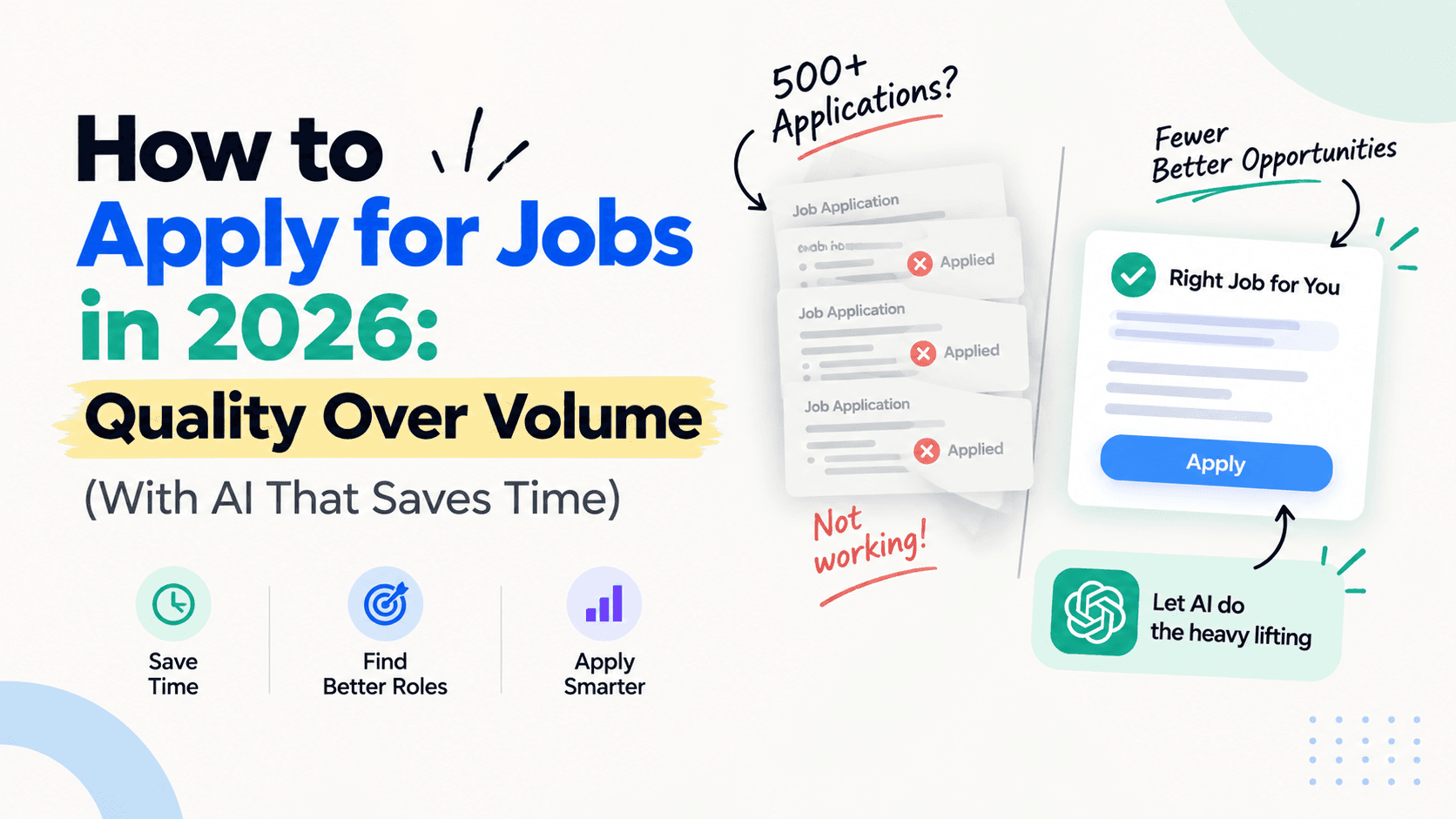
Learn how to apply for jobs in 2026 with fewer, stronger applications. Use AI to research roles, tailor materials, and track outreach—without burning out on 500 submissions.
The Volume Trap Is Dead—Long Live the Targeted Application
Applying for jobs in 2026 looks easier than ever—one click imports your LinkedIn profile, AI writes a cover letter, and you submit in thirty seconds. So why do so many candidates still hear nothing back? Because everyone else has the same tools. When hundreds of applicants send semantically similar AI-polished resumes into the same req, two-layer ATS and LLM screening still has to rank someone first—and generic profiles sink.
The new rule for how to apply for jobs in 2026 is simple to say and hard to discipline: quality over volume. Fewer applications, each with clearer fit, better evidence, and intentional follow-up. AI should save you time on research and editing—not automate away strategy.
What "Quality" Means in a Modern Application
A quality application is not a longer cover letter. It is a coherent package where every piece reinforces the same story:
Your resume proves you have done the work before.
Your short cover note (or email) explains why this team, now.
Your LinkedIn profile matches your resume facts exactly.
Your outreach (if any) shows you understand the company's problem space.
Quality also means honesty. Skills-based hiring only works when skills are real. Exaggerated AI-inflated bullets might get you past a first filter and fail you in a technical screen.
Step-by-Step: The 2026 Quality Application Workflow
1. Triage the Role in 5 Minutes
Before you customize anything, score the req:
Must-have skills: Do you have them with examples?
Seniority: Is the scope realistic for your history?
Location and work model: Compatible?
Signal quality: Is the posting specific about team and projects, or vague boilerplate?
If you fail must-haves, do not apply hoping for mercy. Bank that time for a better match.
2. Extract the Real Requirements with AI Assistance
Paste the job description into an AI tool and ask for:
Top 8 technical and behavioral requirements
Implicit responsibilities (things assumed but not stated)
Language repeated multiple times—likely important for semantic matching
You are not looking for keywords to spam. You are building a checklist of evidence you need on page one of your resume.
3. Tailor the Top Third of Your Resume
Full rewrites for every job are unsustainable. Instead, customize:
Professional summary (3 lines)
Most recent role's top 3 bullets
Skills section ordering
This is where AI as editor shines: propose alternate phrasing aligned to the req while you verify accuracy. Avoid letting a model invent projects.
4. Write a Short, Specific Cover Note
Many teams skip cover letters—but when optional fields exist, a tight note still helps humans. Structure:
One sentence: role + why this company
Two sentences: your most relevant win with metrics
One sentence: enthusiasm + availability
Under 150 words. Recruiters thank you.
5. Apply Through the Best Channel
Multi-channel search matters at submission time too:
If you have a referral, apply and ask your contact to flag internally the same day.
If you met a recruiter, email them directly with req ID and resume attached.
If you are cold applying, prefer the company's own career portal when possible.
Indeed and LinkedIn Easy Apply are useful for discovery—not always for differentiation.
6. Log and Follow Up Once
Track company, role, date, channel, contact, and status. One polite follow-up after 7–10 business days is reasonable for roles where you had human contact or a referral. Silence after a cold apply is normal; do not spam.
Where AI Saves Time (Without Replacing You)
Used well, AI compresses hours of drudge work:
Summarizing long job postings and earnings calls for company research
Drafting outreach messages you personalize heavily
Comparing your resume to a job description and highlighting gaps
Generating interview question lists from the req
Simulating behavioral questions after you apply—prep starts immediately
Interview Trix combines several of these loops: build a structured resume, run mock interviews, and review your iX report to sharpen answers before recruiters call. That is AI supporting a quality workflow—not spraying applications.
Semantic Matching: What to Align (and What to Ignore)
Align your evidence to meaningful requirements—product analytics, security compliance, enterprise sales cycles—not every nice-to-have. Semantic systems reward contextual fit. Mention "customer onboarding" if the role owns activation, even if the posting also lists ten peripheral tools you have touched once.
Ignore the urge to mirror the job description word-for-word. Recruiters recognize pasted JD language instantly.
Quantify Achievements Every Time You Apply
Before submitting, ensure at least three quantified bullets appear above the fold: revenue influenced, latency reduced, support tickets deflected, adoption increased, costs saved, audit findings resolved. Numbers anchor credibility in automated and human review.
If you lack exact metrics, use defensible ranges and explain scope: "Supported rollout to ~15 enterprise accounts" is better than "Worked with enterprise clients."
Sample Weekly Calendar: 8–10 Hours While Employed
2 hours: Discovery—shortlist 6–8 roles across LinkedIn, Indeed, referrals, company sites
3 hours: Submit 3–4 quality applications with tailored top thirds
2 hours: Networking messages and one informational chat
1–2 hours: Mock interview or skills refresh tied to upcoming screens
That rhythm yields roughly a dozen strong applications per month—far more effective than 100 generic ones.
Red Flags That Mean "Do Not Apply Yet"
You cannot explain why this company specifically
Your resume lacks a single bullet addressing the core responsibility
You are applying down-level out of desperation without reframing scope
The posting duplicates the same req every week—possible pipeline fishing
You would need to falsify skills to pass screening
Quality also means protecting your confidence. Rejection hurts less when you believed in the fit.
Trust and Transparency When Using AI to Apply
Some employers now ask whether candidates used AI to generate materials. When asked, answer honestly within policy. Transparency builds trust; misrepresentation breaks it. Use AI to clarify your real story—not fabricate one.
Similarly, expect employers to be clearer about automated screening over time. Candidates deserve to know when AI ranks applications. Advocate for yourself if a process feels opaque or unfair—but lead with strong, verifiable materials first.
Metrics That Prove Quality Over Volume Is Working
Track conversion rates, not just activity:
Applications → recruiter screens
Screens → hiring manager interviews
Interviews → offers
If your application volume is low but screen rate improves, your strategy is working. If volume is high and screens are zero, fix positioning before adding more clicks.
Key Takeaways
In 2026, how to apply for jobs successfully means fewer, stronger packages—not endless Easy Apply clicks.
Use AI for triage, research, and editing—not as a ghostwriter for experience you lack.
Tailor summaries and recent bullets; keep facts consistent across resume and LinkedIn.
Choose the best submission channel: referrals and direct contact beat anonymous queues.
Combine applications with interview prep and feedback loops the same week you submit.
Quality over volume is not about applying less because you are lazy. It is about applying less because you are strategic—and using AI to make each application count.
Building an Application Tracker That Actually Helps
Spreadsheets beat memory. Track at minimum: company, role title, req ID, date applied, channel (referral, LinkedIn, company site), contact name, status, follow-up date, and notes from research. Color-code by priority tier. When AI summarizes a job description, paste the must-have list into the row—future you will know why you applied.
Review the tracker weekly. Patterns emerge: which channels convert, which resume variant performed better, which industries ghost you. Data beats anxiety when job searches stretch months.
Stretch Roles vs. Wrong Roles: A Decision Framework
Quality applications include thoughtful stretch roles—one level up or a adjacent domain where 70% of skills transfer. Wrong roles waste cycles: mismatched seniority, unrelated industry, or missing must-have credentials. Before stretching, identify two proof bullets you will lead with and one gap you can address honestly in a cover note ("I have not owned a P&L, but I managed a $400k project budget with weekly exec reporting"). If you cannot articulate the stretch narrative, wait for a better fit.
Combining Quality Applications With Interview Momentum
Job searches fail when application bursts alternate with interview rust. After each quality submission, spend 20 minutes prepping likely questions for that company—product strategy, system design, or behavioral scenarios tied to their stack. Continuous prep means you never start cold when a recruiter calls within 48 hours. That rhythm separates candidates who sound polished from those who scramble.
Negotiating Timeline Without Losing Quality
If you need to accelerate—visa deadlines, layoff runway—compress discovery but not tailoring. Apply to fewer companies per day with tighter focus rather than restoring volume. Batch similar roles (three backend platform reqs) and tailor once with light per-company tweaks to summary and cover notes. AI diff tools help spot which bullets need swapping between similar postings.
What Recruiters Wish Candidates Knew in 2026
Recruiters are not gatekeepers for sport—they are matching humans to hiring manager specs under time pressure. Clarity wins: subject lines with role title and req ID, resumes that match LinkedIn, honest skill lists, and follow-ups that add value (new portfolio link, not "just checking in"). Quality applications respect recruiter workflow and get remembered when the next req opens.