AI Job Search Strategy for 2026: Find Better Roles Without Applying to 500 Listings
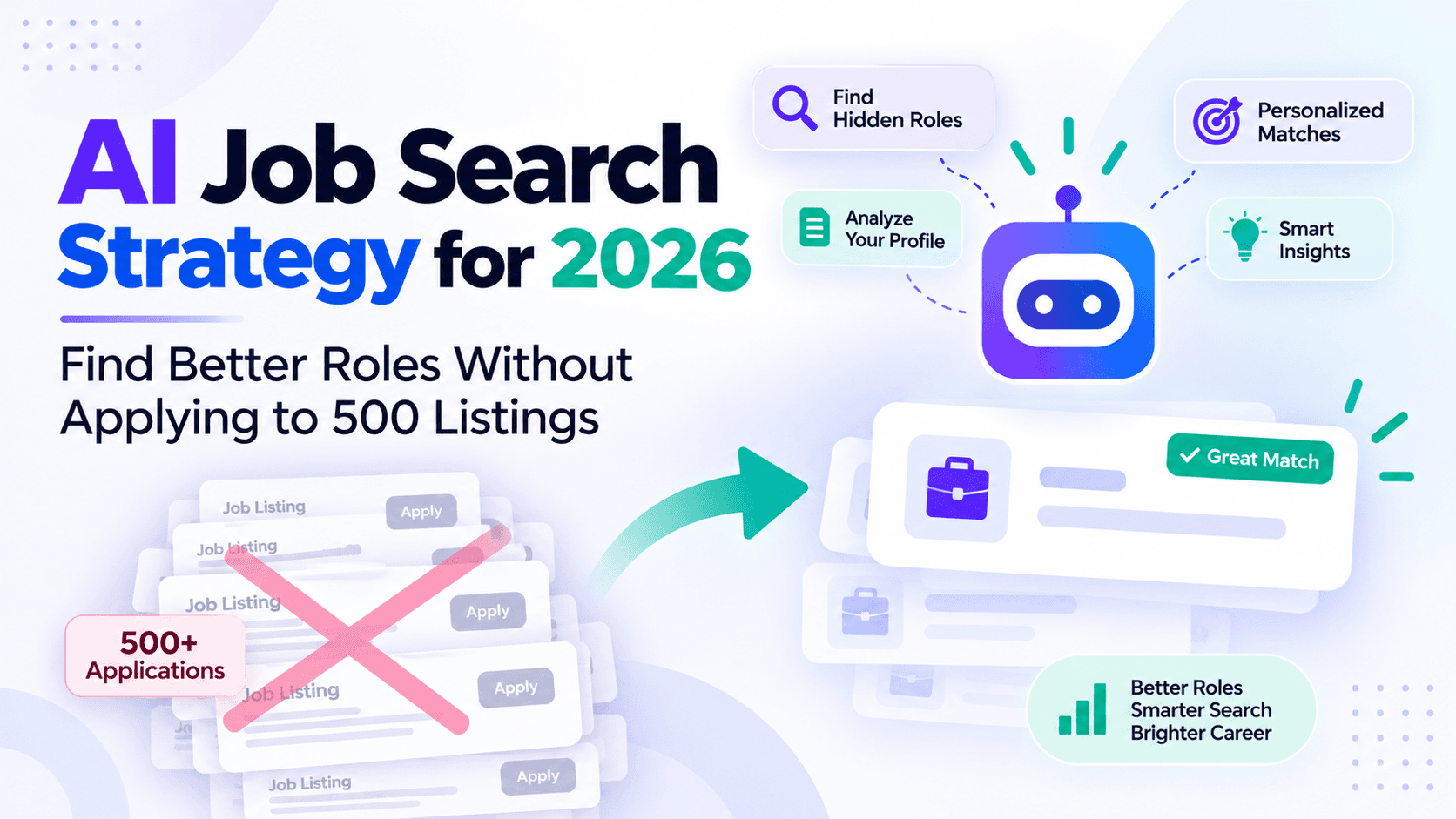
Stop spray-and-pray applications. Learn a 2026 AI job search strategy built on semantic matching, targeted outreach, and quality applications that pass two-layer ATS and LLM screening.
The 2026 Job Search Has Changed—Your Strategy Should Too
If you spent 2024 or 2025 applying to hundreds of roles and hearing almost nothing back, you are not alone—and you are not necessarily doing anything "wrong." The hiring funnel itself has changed. In 2026, most mid-size and enterprise employers run a two-layer screening process: a traditional Applicant Tracking System (ATS) filters and ranks candidates first, and then an AI-assisted review layer—often powered by large language models—evaluates fit, skills overlap, and narrative clarity before a human recruiter ever opens your file.
That shift rewards a completely different strategy than the old "apply everywhere" playbook. The winners in 2026 are not the people who submit 500 applications. They are the people who submit 30 to 50 highly aligned applications, backed by resumes that machines can parse, semantic evidence of skills, and multi-channel visibility through LinkedIn, referrals, and direct outreach.
This guide walks through a practical, research-backed AI job search strategy for 2026—one that saves time, reduces burnout, and increases your interview rate without gaming the system.
Why Volume Applications Fail in the Age of AI Screening
Mass applying feels productive because it creates motion. You update a template, upload a PDF, click submit, and repeat. But recruiters and hiring managers have told researchers for years that quality beats quantity—and in 2026, the machines agree.
Modern ATS platforms do not simply count keyword matches. They use semantic matching: comparing the meaning of your experience against the meaning of the job description. If you keyword-stuff "Python, Python, Python" without context, you may pass a crude filter but fail semantic scoring. Worse, LLM-assisted reviewers can flag resumes that read artificially optimized—because they often are.
Volume also destroys your signal. When you apply broadly, you cannot tailor achievements, you cannot research each team, and you cannot follow up meaningfully. You become one of thousands of interchangeable profiles. A focused AI job search in 2026 treats each application as a small project, not a checkbox.
The Two-Layer Filter: ATS First, Then AI Review
Think of screening in two passes:
Layer 1 — ATS parsing and ranking: The system extracts your work history, skills, titles, dates, and education. It checks basic requirements (years of experience, location, work authorization) and ranks you against other applicants using structured data plus semantic similarity to the job description.
Layer 2 — AI-assisted shortlisting: Recruiters use tools that summarize candidates, highlight skill gaps, compare profiles side by side, and sometimes score "likely fit." This layer reads your resume more like a human would—looking for coherent career progression, relevant impact, and credible evidence.
Your strategy must satisfy both layers. That means clean formatting for parsers and substantive, quantified content for semantic and human readers.
Step 1: Define Your Target Lane Before You Touch a Job Board
The biggest time leak in job searches is ambiguity. "Open to anything" sounds flexible, but it produces unfocused resumes and random applications. Before you use any AI tool, write a one-page target profile:
Role family: e.g., backend engineer, product manager, data analyst
Seniority band: match your last 2–3 years of scope, not your aspirational title
Industry constraints: fintech, healthtech, B2B SaaS—pick 2–3 where your story makes sense
Non-negotiables: remote, compensation floor, visa sponsorship
Proof points: 5–7 achievements you can quantify and reuse with variation
This profile becomes the prompt context for every AI assistant you use. AI works best as an editor and strategist when you give it constraints—not when you ask it to "find me a job."
Step 2: Build an AI-Readable Resume (GEO for Hiring)
You may have heard of GEO—Generative Engine Optimization—as a way to make content legible to AI systems. The same principle applies to resumes in 2026. Recruiters call it "ATS-friendly," but the deeper idea is machine-readable career data with human-readable impact.
An AI-readable resume includes:
Standard section headings: Summary, Experience, Skills, Education
Reverse-chronological roles with clear dates and employer names
Bullet points that start with strong verbs and include metrics
A dedicated skills section that mirrors language from your target roles—naturally, not stuffed
No tables, text boxes, or graphics that break parsing
Tools like the Interview Trix resume builder help you maintain a master resume with consistent structure while generating role-specific variants. The goal is not one perfect PDF—it is a structured source of truth you can adapt quickly.
Quantify Achievements—Machines and Humans Both Love Numbers
Semantic matching still needs evidence. Compare these bullets:
Weak: "Worked on improving API performance."
Strong: "Reduced p95 API latency by 38% (420ms → 260ms) by redesigning caching and query batching for 2M daily requests."
The strong version gives an LLM concrete tokens to match against job requirements: performance, APIs, scale, optimization. It also builds trust with human reviewers. In 2026, skills-based hiring does not mean "skills without proof." It means provable skills demonstrated through outcomes.
Step 3: Use AI as an Editor, Not a Ghostwriter
AI can draft, rewrite, and compare—but your resume should still sound like you. Recruiters and hiring managers are increasingly sensitive to generic, model-smoothed language. Phrases like " leveraged synergies to drive impactful outcomes" are red flags.
A healthy workflow:
You write rough bullets from memory and old project notes.
AI suggests tighter phrasing, metric placement, and alignment to a job description.
You edit for voice, accuracy, and specificity—remove anything you cannot defend in an interview.
You run a final check for truthfulness and consistency across dates and titles.
Transparency matters. If you use AI, you are still accountable for every claim. The best candidates treat AI like a sharp colleague, not a replacement for experience.
Step 4: Run a Multi-Channel Search, Not a Single-Platform Habit
Job boards are necessary but insufficient. A 2026 AI job search uses multiple channels deliberately:
LinkedIn: Optimize your headline and About section for semantic search. Engage with content from target companies. Use alerts, but prioritize connections and recruiter relationships.
Indeed and niche boards: Good for volume discovery—but filter aggressively before applying.
Referrals: Still the highest-conversion channel. Warm introductions bypass some anonymous queue pain.
Company career pages: Apply directly when you have strong fit; some ATS pipelines treat source quality differently.
Communities: Slack groups, alumni networks, open-source communities—where hiring managers actually hang out.
AI tools can help you track companies, summarize job descriptions, and draft outreach messages—but the channel strategy is yours. Spend 40% of your time on applications, 30% on networking and referrals, 20% on interview prep, and 10% on learning and portfolio updates.
Step 5: Apply Less, Align More
Here is a simple scoring rubric before you apply:
Skills overlap: Do you meet 70%+ of core requirements with real examples?
Story fit: Does this role logically follow your last 2–3 years?
Evidence: Can you add 2–3 tailored bullets without inventing experience?
Network angle: Can you find an employee, alum, or recruiter to learn more?
Excitement: Would you accept an offer if compensation matched?
If you score low on overlap or story fit, save the hour you would spend applying and invest it in a better-targeted role. Quality over volume is not a motivational poster—it is math when acceptance rates are single digits.
Step 6: Prepare for AI-Assisted Interviews and Assessments
Screening does not end at the resume. Video interviews, async assessments, and structured panel interviews increasingly use AI scoring for communication clarity and competency signals. Prepare accordingly:
Practice structured answers (STAR format) out loud.
Run mock interviews with feedback on pacing, clarity, and depth.
Review your own recorded answers—AI tools can help summarize improvements, but you need the reps.
Platforms like Interview Trix offer mock interviews and detailed feedback reports—including the iX report—so you can identify weak answers before a real hiring manager does. Interview prep is part of search strategy, not a separate phase after you get lucky.
Trust, Transparency, and the Future of AI Hiring
Employers are under growing pressure to explain how AI influences hiring decisions. Regulations and candidate expectations are pushing toward more transparency: what data is collected, how automated scoring works, and how to request human review. As a candidate, you should also practice transparency—represent your skills honestly, disclose AI assistance where appropriate in process guidelines, and avoid submitting synthetic work samples as your own.
The candidates who thrive in 2026 combine ethical clarity with tactical sophistication: resumes machines can read, applications humans can trust, and interview performance that backs every bullet on the page.
Your 2026 AI Job Search Weekly Plan
Block your calendar consistently. A sustainable weekly rhythm:
Monday: Research 10 target companies; shortlist 5 roles using your scoring rubric.
Tuesday–Wednesday: Tailor 3–5 applications with customized bullets and outreach messages.
Thursday: Networking—3 thoughtful LinkedIn messages, 1 coffee chat, 1 follow-up.
Friday: Mock interview practice and resume refinement based on feedback.
Weekend: One deep project update (portfolio, GitHub, case study) every two weeks.
Key Takeaways
Modern hiring uses two-layer ATS + LLM screening—optimize for parsing and semantic evidence, not keyword stuffing.
Define a narrow target lane; AI tools need constraints to be useful.
Build an AI-readable resume with quantified achievements and standard structure.
Use AI as an editor, not a ghostwriter—accuracy and voice still matter.
Run a multi-channel search: LinkedIn, referrals, boards, and direct outreach.
Apply fewer times with higher alignment; prep interviews continuously with mock sessions and feedback.
The goal of an AI job search in 2026 is not to automate your way into more rejections. It is to spend your limited attention where it compounds: clearer positioning, stronger proof, better conversations, and interviews you are ready to win.